

The modern kitchen has transformed from a closed, purely utilitarian food preparation room into the dynamic heart of the home. It is a space for creative culinary experiments, family gatherings, and multimedia consumption. With the explosion of high-definition YouTube cooking tutorials, live-streamed masterclasses, and digital recipe apps, screen integration has shifted from a luxury to an absolute necessity. لكن, the kitchen environment presents a hostile set of challenges for standard electronics: airborne grease, high humidity, variable heat zones, and spatial constraints.
For years, interior designers and tech enthusiasts defaulted to installing fixed, wall-mounted TVs or expensive, custom-built-in cabinetry screens. While these legacy solutions seem practical on paper, they consistently fail in real-world culinary workflows.
To solve this problem, a new category of commercial-grade hardware has emerged: the kitchen smart screen with wheels. In this comprehensive engineering and user-experience breakdown, we will examine the critical technical flaws of wall-mounted monitors in culinary spaces and why a high-performance, rollable, responsive smart screen is the ultimate solution for professional home chefs.
1. The Geometry of Cooking: Why Fixed Screens Fail the Ergonomic Test
Cooking is inherently three-dimensional and highly dynamic. A home chef does not remain stationary; the culinary process requires constantly moving between the central kitchen island, the prep counter, the stovetop, and the sink. This fluid movement exposes the fatal flaw of any fixed display: the static viewing angle.
The Danger of “Blind Spots” and Neck Strain
When a display is permanently fixed to a wall or tucked beneath an upper cabinet, its optimal viewing sweet spot is restricted to a narrow 30-degree cone. If you are standing at the island chopping vegetables while your YouTube tutorial is playing on a wall-mounted TV behind the stovetop, you are forced to constantly twist your neck or turn your entire body. This awkward posture is more than just uncomfortable; it is a safety hazard when handling professional chef knives or working with hot oils.
The Smartphone Compromise
Frustrated by fixed screen positions, millions of home cooks resort to propping their smartphones or standard consumer tablets against a spice jar or blender. This creates an even worse ergonomic bottleneck. The cook is forced to hunch over, squinting at a tiny 6-inch or 10-inch screen that is easily obscured by mixing bowls. Even worse, these lightweight devices are highly unstable, frequently slipping into pools of spilled water or flour.
2. Real-World Engineering: The Rollable Smart Screen Solution
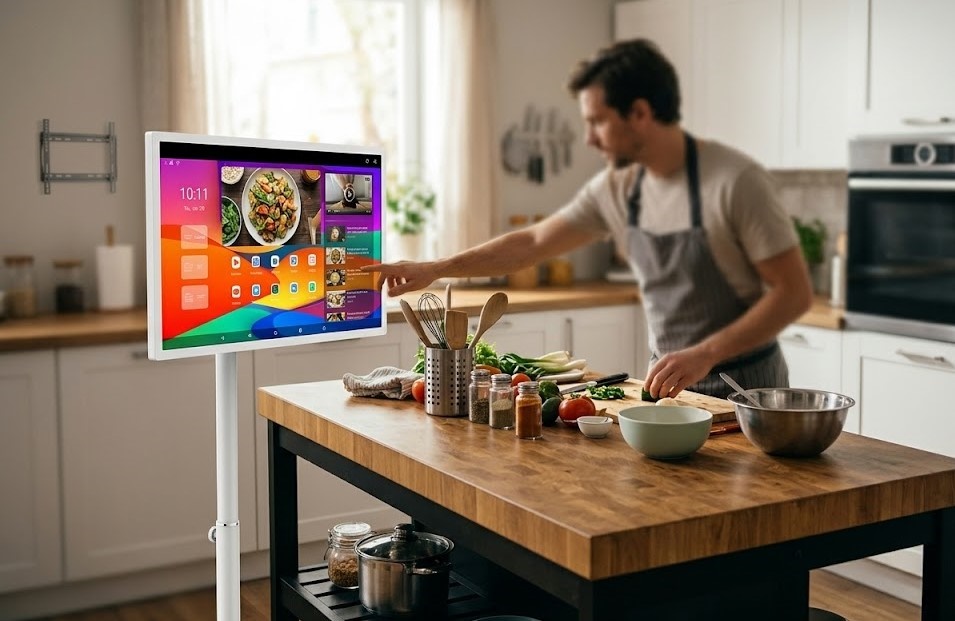
أ movable TV for kitchen use completely rewrites the ergonomics of culinary technology. Instead of forcing the chef to adapt to the screen, a rollable display adapts instantly to the chef’s position.
Imagine preparing an intricate French pastry recipe. You begin at the pantry, grabbing dry ingredients; your rolling smart screen sits right beside you, displaying the precise measurements. التالي, you wheel the display over to your central island to watch an artisan baker demonstrate the exact hand-folding technique at eye level. Finally, you move the screen adjacent to the cooktop to monitor the precise temperature reduction timing. The screen effortlessly follows your workflow, ensuring you never miss a critical visual cue.
Paradigm Comparison: Fixed vs. Mobile Displays
| Feature Paradigm | Traditional Wall-Mounted Kitchen TV | OPULUX Kitchen Smart Screen with Wheels |
| Viewing Flexibility |
Fixed location. Severe glare from ambient windows; causes blind spots at prep stations. |
Infinite mobility. 360-degree rotation, vertical height adjustment, and seamless tilt control. |
| Interactive Control |
Remote control only. Impossible to use cleanly while actively handling ingredients. |
Advanced 10-point capacitive touch screen with ultra-responsive sub-7ms latency. |
| Environmental Durability |
Static targets for airborne grease, oil particles, and steam. Blocked ventilation risks burnout. |
Sealed, wipe-clean glass panels. Can be wheeled completely out of high-smoke zones when searing. |
| Installation Cost |
عالي. Requires drywall drilling, hidden cable management, and dedicated electrical outlets. |
Zero installation. Completely standalone with an integrated high-capacity battery. |
3. The Tactical Interface: Sub-7ms Latency & 10-Point Touch
The kitchen environment is wet, sticky, and fast-paced. This makes traditional control interfaces like physical remotes or standard low-grade touchscreens completely useless.
The Absolute Failure of Voice Control and Remotes
Many smart TVs advertise voice activation as the ultimate hands-free kitchen solution. لكن, anyone who has actually tried using voice commands while a range hood is roaring on high speed, water is running, and a blender is cycling knows that the technology fails in noisy environments. على الجانب الآخر, reaching for a plastic remote control with hands covered in olive oil or raw bread dough ruins the hardware and creates a massive cross-contamination risk.
The Power of High-Fidelity 10-Point Capacitive Touch
This is where the OPULUX engineering standard sets a new benchmark. The ultimate best portable display for cooking videos must be equipped with a commercial-grade, multi-touch capacitive glass surface. 10-point touch technology allows for intuitive, smartphone-like gestures—such as pinching to zoom in on an intricate ingredient list or swiping instantly to the next step of a recipe layout.
More importantly, the display controller must feature an ultra-low latency response time of <7 milliseconds. When your hands are wet or slick with oil, standard touch screens often misregister inputs or lag, forcing you to repeatedly tap the glass in frustration. A sub-7ms response rate ensures that even a quick, light tap with a damp knuckle instantly pauses a fast-moving video. This precise responsiveness allows you to control your timeline precisely, ensuring your food never overcooks while you struggle with an unresponsive user interface.
4. Combating the Kitchen Element: Anti-Grease, Moisture, and Maintenance
Airborne grease and localized moisture are the silent killers of premium home electronics. When cooking, frying, or boiling, tiny droplets of aerosolized lipids and water vapor fill the air. These particles settle on any nearby surfaces, forming a sticky, resilient film that clogs cooling vents and degrades electronic components.
The Wall-Mounted TV Traps Dirt
Because wall-mounted TVs are fixed in place, they become passive collectors of kitchen grease. Cleaning behind a wall bracket is notoriously difficult, creating a hidden fire hazard and a breeding ground for bacteria. Over time, the acidic nature of cooking oils can corrode internal solder joints, leading to premature display failure.
Active Avoidance & Seamless Maintenance
A rollable smart display elegantly bypasses this environmental threat through two design advantages:
-
Active Mobility Positioning: When you are performing high-smoke, high-splatter tasks—such as searing a steak in a cast-iron skillet—you can simply roll the smart screen two meters back from the stove. It stays perfectly within your line of sight but safely out of the splatter zone.
-
Wipe-Clean Engineering: Premium mobile displays feature a completely flat, edge-to-edge tempered glass face with an oleophobic coating. If flour, butter, or liquid splatters onto the screen, it can be wiped down instantly with a damp microfiber cloth and mild sanitizing spray. There are no recessed plastic bezels or open speaker grilles for grime to collect in.
5. The OPULUX Design Vision: Beyond Cooking
While the utility of a rolling screen shines brightest during food preparation, its mobile design offers immense value across your entire living space once dinner is served.
The Ultimate Entertainment Extension
When dinner is ready, you can seamlessly roll the display directly to the dining table or kitchen island bar. It instantly shifts from an active culinary guide to a beautiful entertainment center for streaming shows, displaying digital art, or playing ambient dinner music through its integrated high-fidelity soundbase.
A Multi-Room Investment
Unlike a wall-mounted TV that is permanently stuck in one room, a smart screen with wheels can easily transition to other areas of your home. It can serve as a mobile dashboard for your home gym, a secondary presentation monitor for your home office, or a portable entertainment center for an outdoor patio barbecue. This versatility delivers a much higher return on investment compared to any single-room fixed installation.
خاتمة: Upgrade Your Culinary Space with OPULUX
Investing in high-end knives, commercial-grade ranges, and premium ingredients is wonderful, but the tech infrastructure supporting your workflow matters just as much. Fixed wall-mounted TVs are an outdated remnant of living room design forced into a dynamic workspace. They create blind spots, collect grease, and isolate you from your digital tools.
The transition to a dedicated kitchen smart screen with wheels is a significant upgrade for your kitchen’s ergonomics, safety, and overall enjoyment. By delivering mobile flexibility, crisp anti-glare visuals, and a highly responsive, wipe-clean touch interface, this innovative device ensures that the ultimate digital sous-chef is always exactly where you need it.
Discover the next evolution of home display systems. Explore the premium line of intelligent, mobile displays at OPULUX Hardware Solutions and redefine your smart home ecosystem today.