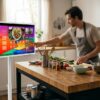

When restaurant owners and retail operators upgrade their traditional signage, they frequently struggle with technical specifications. Specifically, many commercial buyers ask our engineering team at リッチ: “How many nits of brightness do I actually need for an indoor screen? Will a standard 250-nit display work, or must I invest in a 500-nit commercial monitor?”
To maximize your return on investment and safeguard your brand image, this technical guide evaluates how ambient commercial illumination impacts screen readability. その結果, you will discover why choosing the correct luminance rating is critical for your business environment.
The Physics of Commercial Spaces: Understanding Lux vs. ニッツ
To make an educated procurement decision, you must first understand the relationship between indoor environmental light (measured in Lux) and screen brightness (measured in Nits). Standard household environments usually maintain low, diffused lighting. 対照的に, modern commercial spaces feature high-intensity illumination architectures.
The Ambient Light Challenge
-
The Commercial Reality: Modern fast-casual restaurants, shopping mall food courts, and corporate lobbies utilize powerful LED spotlights, fluorescent tubes, and expansive glass fronts. As a result, these spaces routinely reach ambient light levels between 800 Lux and 1,500 Lux.
-
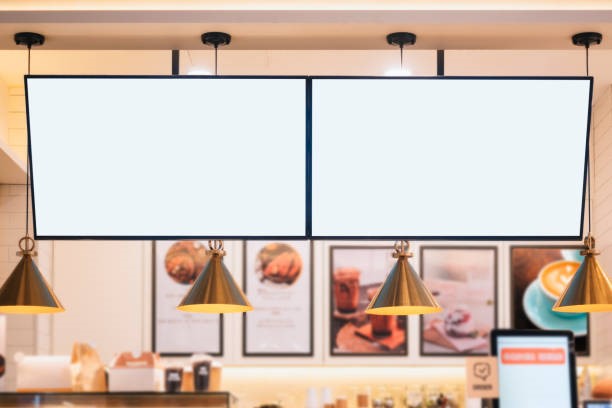
The Display Solution: To overcome this intense environment, の LCDデジタルメニューボード must emit enough raw luminance to overpower the ambient glare. If your display lacks sufficient nit output, the ambient lighting will completely wash out your content.
Head-to-Head Comparison: 250 ニッツ vs. 500 ニッツ
| Performance Dimension | 250 ニッツ (Consumer-Grade Display) | 500 ニッツ (Opulux Commercial Grade) |
| Optimal Environment | Dim bedrooms, home offices, low-light living rooms. | High-lux retail environments, modern food courts, bright supermarkets. |
| Glare & Reflection | Suffers severe reflection issues; functions like a dark mirror under direct spotlights. | Defeats commercial glare effectively due to advanced anti-glare coatings and high luminance. |
| Visual Precision | Washes out contrast, which makes text illegible and colors dull. | Preserves true color saturation and immaculate 4K Ultra HD razor-sharp detail. |
| Operational Lifespan | Degrades quickly when forced to run at 100% brightness 24/7. | Engineered with industrial components for continuous 24/7 commercial operation. |
Detailed Application Analysis
1. The 250-Nit Trap: Why Consumer TVs Fail in Business
Many business owners mistakenly buy consumer-grade TVs to save on upfront costs. しかし, these residential screens typically offer only 250 nits of brightness.
When you place a 250-nit screen under commercial fluorescent tubes, the display immediately loses its contrast. したがって, your customers will struggle to read item prices, which directly increases ordering friction. さらに, the glossy panels on consumer TVs reflect the entire room, which creates an incredibly unprofessional, mirror-like distraction.
2. The 500-Nit Sweet Spot: The Golden Ratio for Indoor Commercial Lighting
Conversely, リッチ engineers our premium LCD digital menu board solutions with a native 500-nit luminance rating. Through extensive field testing, we verified that 500 nits represents the perfect “golden ratio” for indoor commercial applications.
First, 500 nits provides exactly enough power to slice through high-lux ambient glare without blinding your customers. Second, this brightness level allows the display to preserve its stunning 4K Ultra HD razor-sharp detail, which makes your food photography look incredibly vibrant and appetizing. Finally, because our commercial panels do not need to run at their absolute thermal limits to achieve this brightness, they run cooler and last significantly longer than consumer alternatives.
Procurement Framework: Choosing the Right Screen
When you evaluate potential display hardware from a global 4K commercial menu board factory, apply this simple environmental checklist to guarantee perfect legibility:
Scenario A: Standard Indoor Lighting (Below 500 Lux)
If your boutique or cafe relies entirely on soft, indirect ambient lighting with no direct window exposure, a standard commercial screen might suffice. しかし, choosing a higher baseline protects your visual assets as your store layout changes.
Scenario B: High-Intensity Commercial Illumination (500 に 1,500 Lux)
If your restaurant operates under direct overhead LED spotlights, or if your menu sits near a sunlit window array, you must deploy a 500-nit LCDデジタルメニューボード. This decision ensures that your pricing matrix remains perfectly legible from across the counter.
Partner with Opulux for High-Performance Commercial Displays
As an industry-leading manufacturer of commercial display technology, リッチ designs high-reliability wholesale digital menu screens that elevate the modern dining and retail experience. We combine industrial-grade 500-nit open-cell architecture with state-of-the-art thermal management systems to deliver stunning, uninterrupted performance.
Contact our commercial display consultation desk today to review our complete hardware lineup, request comprehensive pricing catalogs, or secure custom OEM project quotes.